
Air Conditioning Compressor market– Industry Structure Evaluation, Demand Drivers Analysis, Regional Growth Analysis and Identification, Competitive Positioning Review & Global Market Size Forecast to 2032
Overview
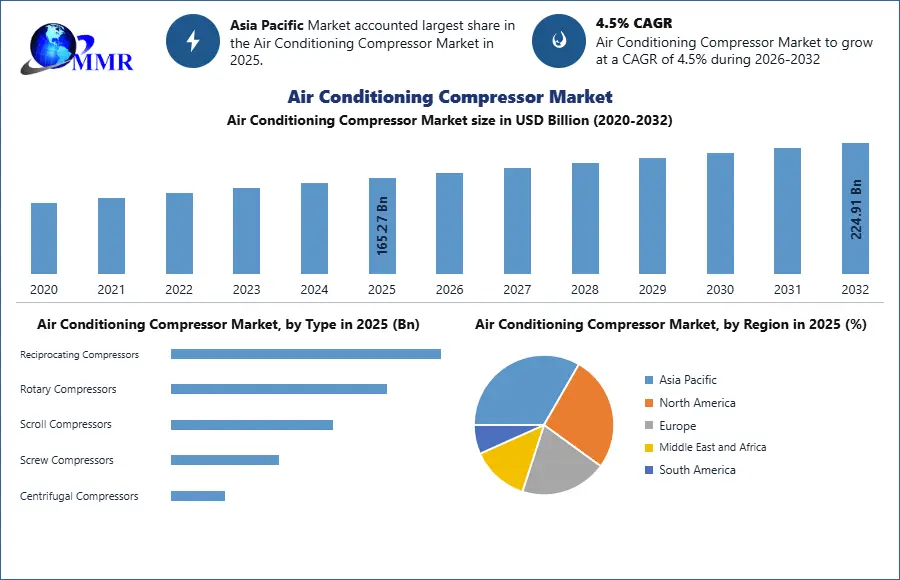
Air Conditioning Compressor Market size reached USD 165.27 Billion in 2025 and is expected to reach USD 254.36 Billion by 2032, growing at a CAGR of 6.42% during the forecast period.
Air Conditioning Compressor Market Overview
The Air Conditioning Compressor Market represents a critical component of the global HVAC (Heating, Ventilation, and Air Conditioning) ecosystem, as compressors act as the core mechanical unit responsible for refrigerant circulation, heat exchange, and cooling efficiency in air conditioning systems. These compressors are widely used across residential air conditioners, commercial HVAC systems, industrial cooling equipment, automotive air conditioning, and data center cooling infrastructure. The market is characterized by continuous technological evolution, shifting regulatory frameworks, and increasing demand for energy-efficient cooling solutions.
The growth trajectory of the Air Conditioning Compressor Market is strongly influenced by rising global temperatures, urbanization, and increasing disposable income, particularly in emerging economies. According to international energy agencies, global cooling demand is expected to increase significantly, with air conditioning units projected to exceed 5 billion installations by 2050. This exponential growth in cooling infrastructure directly drives compressor demand, as compressors constitute approximately 20–30% of the total HVAC system cost.
Technological advancements have played a transformative role in shaping the market. The shift toward inverter-based compressors, variable-speed systems, and low Global Warming Potential (GWP) refrigerants has improved system efficiency and reduced energy consumption. Innovations such as scroll compressors and digital control systems have enabled higher performance, reduced noise levels, and improved operational reliability.
The demand outlook for the Air Conditioning Compressor Market remains robust, supported by expanding residential construction, commercial infrastructure development, and the rapid growth of data centers and industrial facilities. Additionally, government regulations promoting energy efficiency and sustainability are accelerating the adoption of advanced compressor technologies. As the global focus shifts toward decarbonization and energy optimization, the market is expected to witness sustained growth driven by innovation, regulatory compliance, and increasing cooling requirements across diverse applications.
Air Conditioning Compressor Market Growth Catalysts
Rapid Urbanization and Rising Cooling Demand
The Air Conditioning Compressor Market has been significantly driven by rapid urbanization and increasing demand for cooling solutions across residential and commercial sectors. Emerging economies such as India, China, and Southeast Asian countries are witnessing large-scale urban expansion, leading to increased construction of residential complexes, commercial buildings, and smart cities. Cooling demand in these regions is growing at an accelerated pace due to rising temperatures and improving living standards. The International Energy Agency has indicated that cooling demand could triple by 2050, highlighting the long-term growth potential for compressors as essential HVAC components.
Energy Efficiency Regulations and Green Building Initiatives
The Air Conditioning Compressor Market is strongly influenced by global regulatory frameworks aimed at improving energy efficiency and reducing greenhouse gas emissions. Governments are implementing stringent standards for HVAC systems, encouraging the adoption of high-efficiency compressors such as inverter and variable-speed technologies. Programs such as energy labeling, green building certifications, and carbon reduction targets are pushing manufacturers to develop compressors with lower energy consumption and reduced environmental impact. These regulations have created a steady demand for advanced compressor technologies in both developed and developing markets.
Technological Advancements in Compressor Design
Technological innovation has played a crucial role in shaping the Air Conditioning Compressor Market. The transition from fixed-speed to variable-speed compressors has improved system efficiency, reduced power consumption, and enhanced user comfort. Scroll compressors and inverter-driven systems offer higher reliability, quieter operation, and better performance under varying load conditions. Additionally, the integration of IoT and smart control systems allows real-time monitoring and predictive maintenance, improving operational efficiency and reducing downtime.
Growth of Commercial Infrastructure and Data Centers
The expansion of commercial infrastructure, including shopping malls, office buildings, hospitals, and data centers, has significantly boosted demand for air conditioning compressors. Data centers, in particular, require advanced cooling systems to maintain optimal operating temperatures for servers and IT equipment. As digital transformation accelerates globally, the demand for efficient cooling solutions continues to rise, supporting the growth of the Air Conditioning Compressor Market.
Air Conditioning Compressor Market Limitations
High Initial Cost of Advanced Compressor Technologies
The adoption of advanced compressor technologies such as inverter-based systems and scroll compressors involves higher initial costs compared to conventional systems. This cost barrier can limit adoption in price-sensitive markets, particularly in developing regions where affordability remains a key concern.
Environmental Regulations on Refrigerants
The Air Conditioning Compressor Market faces challenges related to the phase-out of high Global Warming Potential refrigerants such as HFCs. Compliance with evolving environmental regulations requires manufacturers to invest in new technologies and refrigerant alternatives, increasing production costs and complexity.
Supply Chain Disruptions and Raw Material Volatility
Fluctuations in raw material prices, particularly for metals and electronic components, can impact compressor manufacturing costs. Additionally, global supply chain disruptions can affect production timelines and market availability.
To know about the Research Methodology :- Request Free Sample Report
Air Conditioning Compressor Market Regional Insights
The Asia Pacific Air Conditioning Compressor market revenue is expected to grow at a CAGR of 7.8% during the forecast period. Demand for air conditioning compressors in the Asia Pacific region is being driven by the strong growth of the residential and industrial sectors, as well as the rising usage of air conditioning equipment in these sectors. China has the world's largest population and Residential constructions are in more demand as the population grows. Furthermore, the country's industrial and technological industries are significant contributors to its GDP. As a result, growth in the industrial and residential sectors is pushing the country's sales of air conditioning compressors.
North America is expected to have significant growth in the global Air Conditioning Compressor market. The increasing use of air conditioning compressors in the residential, commercial, medical, and transportation sectors is a significant factor driving demand in the United States market. Demand for air conditioning compressors has increased significantly in recent years as a result of changes in climatic conditions, changing lifestyles, and fast expansion in the residential sector. According to the U.S. Energy Information Administration (EIA), energy usage for cooling the inside of buildings (space cooling) by the residential and commercial sectors in the United States in 2021 was around 389 billion kilowatt hours (kWh).
Air Conditioning Compressor Market Segments Analysis
Air Conditioning Compressor Market Segmentation, by Type
In 2025, the Scroll Compressor segment was the largest in the Air Conditioning Compressor Market due to its superior energy efficiency, reliability, and widespread adoption across residential and commercial HVAC systems. Scroll compressors operate using a continuous compression process, which results in smoother operation, lower noise levels, and higher efficiency compared to traditional reciprocating compressors. These compressors were extensively used in modern air conditioning systems, particularly in inverter-based units, where energy efficiency and performance are critical factors.
The dominance of the scroll compressor segment was driven by increasing demand for energy-efficient cooling solutions and compliance with regulatory standards. Manufacturers preferred scroll compressors due to their compact design, fewer moving parts, and lower maintenance requirements, which reduced operational costs and improved system lifespan. Additionally, the growing adoption of smart HVAC systems and inverter technology further strengthened the demand for scroll compressors, as they offer better performance under variable load conditions.
Air Conditioning Compressor Market Regional Analysis
In 2025, Asia-Pacific was the leading region in the Air Conditioning Compressor Market, driven by rapid industrial growth, expanding urban population, and increasing demand for residential and commercial air conditioning systems. Countries such as China, India, and Japan played a significant role in the region’s dominance due to their strong manufacturing base and high consumption of HVAC systems.
The region benefited from supportive government policies promoting energy efficiency and infrastructure development, which encouraged the adoption of advanced air conditioning technologies. Additionally, Asia-Pacific is a major manufacturing hub for compressors, providing cost advantages and strong supply chain capabilities. The presence of large-scale production facilities, combined with increasing investments in smart cities and commercial infrastructure, further strengthened the region’s position in the market.
Recent Developments
January 2025: A leading HVAC manufacturer introduced a next-generation inverter compressor designed to enhance energy efficiency and reduce carbon emissions. The new compressor utilized advanced variable-speed technology and smart control systems to optimize performance under varying load conditions. This development reflects the increasing focus on sustainability and energy efficiency in the Air Conditioning Compressor Market, as manufacturers continue to innovate to meet regulatory requirements and consumer demand for eco-friendly solutions.
March 2025: A global compressor manufacturer announced a strategic investment in expanding its production capacity in Asia-Pacific to meet growing demand for residential and commercial air conditioning systems. The expansion included the development of advanced manufacturing facilities equipped with automation and digital technologies. This move highlights the importance of regional manufacturing capabilities in supporting market growth and improving supply chain efficiency.
July 2025: A major industry player launched a new line of compressors compatible with low Global Warming Potential refrigerants, addressing the increasing demand for environmentally sustainable cooling solutions. The product line featured improved energy efficiency, reduced environmental impact, and compliance with global regulatory standards. This development underscores the growing importance of sustainability and innovation in the Air Conditioning Compressor Market.
Air Conditioning Compressor Market Scope: Inquiry Before Buying
| Air Conditioning Compressor Market | |||
|---|---|---|---|
| Report Coverage | Details | ||
| Base Year: | 2025 | Forecast Period: | 2026-2032 |
| Historical Data: | 2020 to 2025 | Market Size in 2025: | 165.27 USD Billion |
| Forecast Period 2026-2032 CAGR: | 4.5% | Market Size in 2032: | 224.91 USD Billion |
| Segments Covered: | by Type | Reciprocating Compressors Rotary Compressors Scroll Compressors Screw Compressors Centrifugal Compressors |
|
| by Refrigerant Type | R410A R32 R22 R134a Natural Refrigerants (R290, CO₂, etc.) |
||
| by Cooling Capacity | Up to 5 kW 5–20 kW 20–50 kW Above 50 kW |
||
| by Technology | Inverter Compressors Non-Inverter Compressors |
||
| by End-Use Industry | Residential Commercial Industrial Automotive & Transportation |
||
Air Conditioning Compressor Market, by Region
North America (United States, Canada and Mexico)
Europe (UK, France, Germany, Italy, Spain, Sweden, Austria and Rest of Europe)
Asia Pacific (China, South Korea, Japan, India, Australia, Indonesia, Malaysia, Vietnam, Taiwan, Bangladesh, Pakistan and Rest of APAC)
Middle East and Africa (South Africa, GCC, Egypt, Nigeria and Rest of ME&A)
South America (Brazil, Argentina Rest of South America)
Key Players/Competitors Profiles Covered in the Air Conditioning Compressor Market Report in Strategic Perspective
- Daikin Industries Ltd.
- Mitsubishi Electric Corporation
- Panasonic Corporation
- LG Electronics Inc.
- Samsung Electronics Co. Ltd.
- Emerson Electric Co.
- Johnson Controls International plc
- Carrier Global Corporation
- Hitachi Ltd.
- Toshiba Corporation
- Danfoss A/S
- Bitzer SE
- Copeland Corporation
- Tecumseh Products Company
- Hanon Systems
- Highly Group Co. Ltd.
- Zhejiang Dunan Artificial Environment Co. Ltd.
- GMCC (Midea Group)
- Secop GmbH
- Kulthorn Kirby Public Company Limited
- Rechi Precision Co. Ltd.
- Huayi Compressor Barcelona S.L.
- Dorin S.p.A.
- RefComp S.p.A.
- Frascold S.p.A.